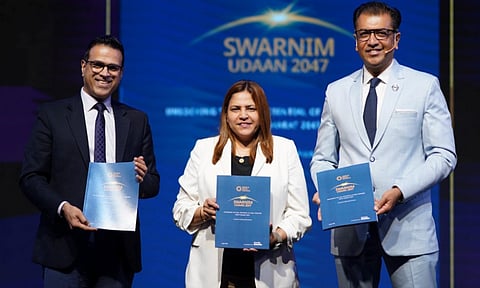

The World Gold Council (WGC) has introduced Swarnim Udaan 2047, a strategic roadmap outlining how gold can become a key driver of India's economic growth as the nation works towards its Viksit Bharat 2047 vision. Developed in collaboration with Monitor Deloitte, the report presents a long-term framework aimed at integrating gold more deeply into India's economic and industrial landscape.
The roadmap envisions India meeting 10–15% of its gold demand through domestic mining, bringing 10–15% of household gold holdings into the formal financial system, and emerging as the world's largest exporter of gold jewellery by 2047. It also recommends the establishment of a National Gold Board and a Gold Innovation Centre to improve policy coordination, encourage technological advancement and support industry-wide collaboration.
Speaking at the launch in Mumbai, Sachin Jain, described the initiative as more than a policy document, calling it a shared roadmap for the entire gold industry. He emphasised that achieving the vision would require collaboration across manufacturers, refiners, retailers, policymakers and consumers, while aligning with Prime Minister Narendra Modi's aspiration of building a developed India by 2047.
Highlighting gold's broader economic role, Jain noted that the metal extends beyond imports and household savings, contributing significantly to employment, exports and value creation across the supply chain. He also stressed its potential to become a stronger strategic asset for the country's long-term growth.
The report is built around five key priorities: expanding domestic gold mining, strengthening jewellery exports, increasing the financialisation of household gold, modernising jewellery to appeal to younger consumers, and enhancing gold's applications in advanced industries including semiconductors, electronics, artificial intelligence and aerospace.
Echoing this vision, David Tait, said India's importance in the global gold ecosystem is expected to grow further, with the roadmap designed to reinforce resource security, manufacturing competitiveness, financial markets and sustainable economic development.
