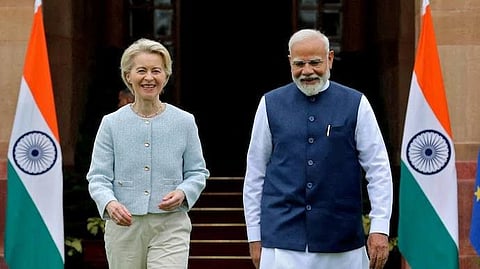

European Commission President Ursula von der Leyen called it “the mother of all deals,” a line that reflects both its scale and its timing. The agreement arrives at a moment when global trade is being reshaped by tariffs, political realignments, and growing uncertainty around long-standing alliances. For the EU, the focus is on reducing reliance on the US and China. For India, it is about opening new export corridors and moving past its protectionist image.
Bilateral trade between India and the EU already stands at over $136 billion, with Europe accounting for more than 17 percent of India’s total exports. This deal is meant to take that relationship much further.
What the Agreement Actually Changes
At its core, the agreement is about tariffs.
The EU will eliminate or reduce duties on 99.5 percent of goods imported from India over a seven-year period. In return, India will lower or remove tariffs on 96.6 percent of EU goods exports to India. This includes everything from industrial equipment and automobiles to wine, chocolates, and premium consumer goods.
Beyond physical products, the deal also covers services, investment, and mobility. It includes commitments across 144 services sectors and binding assurances on student mobility and post-study visas. Dairy products have been kept outside the agreement, reflecting domestic sensitivities in India.
The pact will be formally signed after legal vetting and must be ratified by the European Parliament before it comes into force.
Why This Deal Matters Right Now
The timing of the agreement is as important as its contents. With trade tensions rising elsewhere, both India and the EU are actively diversifying their economic partnerships. Recent trade deals signed by India with the UK, Oman, and New Zealand point to the same strategy.
As global trade becomes less predictable, large economies are choosing stability over dependence. This agreement reflects that shared calculation.
What This Means for the Jewellery Industry
For India’s jewellery sector, the impact of this agreement is unusually clear and direct.
First, Indian jewellery becomes far more competitive in Europe.
Until now, jewellery exports from India to the EU have faced import duties of roughly 2.5 to 4 percent, depending on the category. In a market where pricing margins are tight and retail mark-ups are carefully calibrated, this duty has often limited how aggressively Indian exporters could compete.
Once tariff reductions begin under the FTA, Indian jewellery will enter European markets at a lower landed cost. This allows exporters to price more flexibly without compromising on gold purity, gemstone quality, or craftsmanship. For categories where India already has global strength, such as gold jewellery, diamond-studded pieces, and handcrafted fine jewellery, this levels the playing field.
Second, access expands beyond niche and diaspora markets.
Lower tariffs do more than improve pricing. They change who Indian jewellers can realistically sell to.
Historically, Indian jewellery exports to Europe have been concentrated around diaspora demand or private-label manufacturing. With duties coming down, Indian manufacturers and design-led brands can approach mainstream European retailers, multi-brand boutiques, and luxury distributors with far greater confidence. This creates room for long-term relationships rather than one-off orders and allows Indian jewellery to be positioned as design-led rather than purely cost-driven.
Third, cheaper European technology strengthens manufacturing at home.
The agreement also works in reverse. As India lowers tariffs on European industrial goods, jewellery manufacturers gain easier access to high-precision machinery from countries like Italy and Germany.
Advanced casting, finishing, and stone-setting equipment improves consistency, reduces wastage, and helps meet the strict quality standards expected by European buyers. Lower equipment costs make upgrading production facilities more viable, especially for mid-sized exporters looking to scale.
A Structural Reset, not a Short-Term Boost
This agreement is not about a sudden spike in exports. It represents a structural reset.
For the jewellery industry, it removes a long-standing disadvantage in one of the world’s most valuable luxury markets. It gives Indian jewellers room to price better, sell wider, and manufacture smarter. For an industry built on skill, scale, and centuries of craft, the India–EU Free Trade Agreement is less about opportunity and more about overdue access.