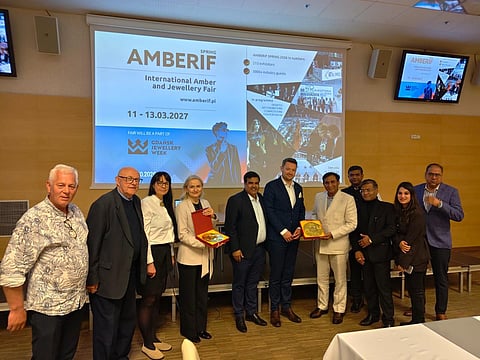

The Gem & Jewellery Export Promotion Council (GJEPC) has concluded a nine-day trade delegation to Poland, Romania and Serbia, laying the groundwork for expanding India's gem and jewellery exports across Eastern Europe and the Western Balkans. The mission, held from 18–26 May 2026, focused on forging institutional partnerships, studying retail markets and creating new avenues for Indian manufacturers through exhibitions, buyer programmes and government engagement.
Led by CoA Member Mital Doshi and accompanied by Regional Director (North) Ashutosh Srivastava, the delegation engaged with chambers of commerce, embassies, jewellery associations, exhibition organisers and retailers across Warsaw, Gdańsk, Bucharest, Belgrade and Novi Sad.
Collectively, Poland, Romania and Serbia represent a gem and jewellery import market worth approximately US$3.51 billion, yet India's overall share remains below 1%, highlighting considerable room for growth. While India already commands strong positions in cut and polished diamonds and ranks fourth in gold jewellery exports across all three markets, GJEPC identified silver jewellery and fashion jewellery as key categories with significant untapped potential.

With imports of over US$2.61 billion, Poland was identified as the delegation's largest commercial opportunity. Retail studies revealed growing demand for lightweight contemporary jewellery, minimalist diamond designs and certified products, aligning well with India's manufacturing strengths.
The visit also resulted in discussions to establish India Pavilions at Gold Expo Warsaw and AmberExpo Gdańsk, alongside a proposed tripartite Memorandum of Understanding between GJEPC, AmberExpo and the Pomeranian Chamber of Handicrafts & SMEs to facilitate long-term trade cooperation.
In Romania, the delegation assessed Bucharest's premium retail landscape and found increasing consumer demand for 14k and 18k gold jewellery, diamond bridal collections and sustainable jewellery offerings.
A key outcome was the establishment of a collaborative framework with the Assamblage National Jewellery Association, covering designer exchange programmes, joint participation during Romanian Jewellery Week and efforts to bring Romanian buyers to IIJS in Mumbai.
Although Serbia represents the smallest market among the three, GJEPC described it as strategically significant due to World Expo 2027, which is expected to position Belgrade as a regional commercial hub.
Meetings with the Embassy of India in Belgrade outlined five priority areas of cooperation, including buyer mobilisation for IIJS, advocacy for favourable trade policies, development of an India Jewellery Exposition (IJX) retail incubation model in Belgrade and discussions around an India Jewellery Pavilion at World Expo 2027.
According to the report, the delegation's broader objective was to address the structural gap between India's manufacturing capabilities and its relatively small presence in Eastern European markets. Over the course of the mission, the team conducted retail studies across more than 25 jewellery establishments while gathering insights into consumer preferences, pricing, merchandising standards and certification requirements.
The report concludes that India's growth in the region will depend less on manufacturing competitiveness—which is already well established—and more on sustained institutional engagement, exhibition participation and stronger buyer connectivity. It identifies the proposed AmberExpo partnership, Romania collaboration, IJX concept and World Expo 2027 roadmap as long-term initiatives that could significantly strengthen India's jewellery exports into Eastern Europe.
According to the report, the delegation's broader objective was to address the structural gap between India's manufacturing capabilities and its relatively small presence in Eastern European markets. Over the course of the mission, the team conducted retail studies across more than 25 jewellery establishments while gathering insights into consumer preferences, pricing, merchandising standards and certification requirements.
The report concludes that India's growth in the region will depend less on manufacturing competitiveness—which is already well established—and more on sustained institutional engagement, exhibition participation and stronger buyer connectivity. It identifies the proposed AmberExpo partnership, Romania collaboration, IJX concept and World Expo 2027 roadmap as long-term initiatives that could significantly strengthen India's jewellery exports into Eastern Europe.