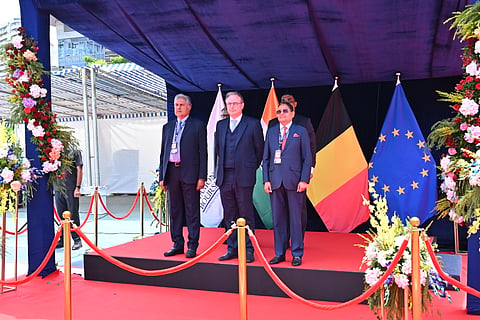
Belgium is looking to deepen its diamond trade relationship with India as the recently concluded India-EU Free Trade Agreement opens new possibilities for lower trade costs, simplified procedures and greater commercial cooperation. That was the key message emerging from Belgian Prime Minister Bart De Wever’s first-ever visit to the Bharat Diamond Bourse (BDB) in Mumbai today—the first visit by a Belgian head of government to the world’s largest operational diamond bourse.
Speaking to senior members of India’s diamond industry, De Wever welcomed the India-EU FTA, saying it would help “boost trade by lowering costs and duties, digitizing and simplifying procedures and aiding interaction.” His visit comes against the backdrop of a century-old relationship between India and Belgium, with Mumbai and Antwerp occupying complementary positions in the global diamond pipeline. India remains the world’s dominant cutting and polishing centre, while Antwerp continues to be a major international trading hub.
De Wever drew a direct connection between the two centres, noting that “India was the cradle where the diamond industry began centuries ago, and Antwerp too has been a key trading centre for the industry since the 15th century.”

The economic relationship is already substantial. India-Belgium gems and jewellery trade stood at around US$3.5 billion in 2025-26, according to Kirit Bhansali, Chairman, Gem & Jewellery Export Promotion Council (GJEPC). “These are not merely figures. They represent businesses, livelihoods, and over five million direct and indirect jobs supporting families across India—all woven into this global value chain,” Bhansali said.
For BDB, the visit was an opportunity to position the two markets as partners rather than competitors. Anoop Mehta, President, BDB, stressed that the relationship extends beyond trade, pointing to the large Indian diamond community in Antwerp and the historic links between the two centres. “Our shared objective should be to create a diamond trade that is not only prosperous, but also fair, transparent and sustainable,” Mehta said.
The significance of the visit was underlined by De Wever’s prediction that the relationship could endure for another century. Describing the diamond as “adamas”—the ancient Greek word for unbreakable—he said: “Our trade runs in two directions and brings advantages to both partners, so it will definitely thrive for at least another 100 years.”
The Belgian delegation also visited GJEPC and the Mumbai Diamond Merchants Association at BDB, before meeting senior representatives of BDB, GJEPC and leading Indian diamantaires with significant business interests in Belgium.
For an industry navigating shifting global trade flows, the symbolism of a Belgian Prime Minister standing inside India’s principal diamond marketplace may ultimately matter less than what follows: whether the new India-EU trade framework can turn a century-old diamond relationship into a more integrated and commercially significant one.