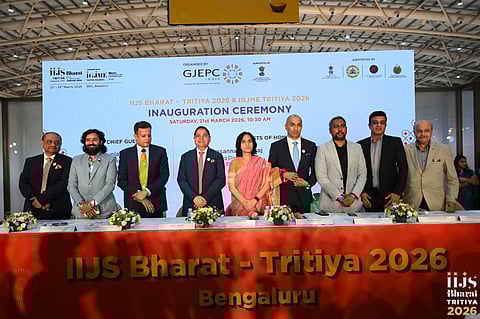

IIJS Bharat – Tritiya 2026 opened in Bengaluru with strong participation and expanded scale, positioning itself as a key sourcing hub for the festive and wedding cycle, while underlining India’s growing influence across global jewellery trade.
IIJS Bharat – Tritiya 2026 commenced at the Bengaluru International Exhibition Centre, bringing together manufacturers, retailers and global buyers at a time when the industry was preparing for its most commercially active period. Organised by the Gem & Jewellery Export Promotion Council, the fourth edition of the show continued to strengthen its role as a focused B2B platform tailored to the procurement needs of southern India while maintaining national and international relevance.
The exhibition scaled significantly this year, featuring over 1,100 exhibitors across more than 1,900 stalls spread over three halls. The show covered a wide spectrum of categories including gold, diamond, silver and studded jewellery, loose natural diamonds, coloured gemstones, lab-grown diamonds, couture collections and machinery. Its positioning within the calendar made it particularly relevant for retailers preparing inventories for the festive and wedding cycle, a period that typically drives a substantial share of annual jewellery sales in India.
Participation remained broad-based, with over 15,000 retailers expected from more than 500 cities across the country, alongside visitors from 40 countries. This continued international presence reflected sustained global interest in Indian manufacturing, especially in categories such as lightweight gold jewellery, studded pieces and design-led collections that cater to evolving consumer preferences.
The inauguration ceremony was attended by senior government officials and industry leaders. Smt. Gunjan Krishna, IAS, Commissioner for Industrial Development and Director of Industries and Commerce, Government of Karnataka, presided as Chief Guest, alongside A. Prasanna Anguraj of Sree Kumaran Thangamaligai and Pratap Madhukar Kamath of Abaran Timeless Jewellery. Leadership from GJEPC, including Chairman Kirit Bhansali and Vice Chairman Shaunak Parikh, were also present, along with representatives from regional trade bodies.
Reflecting on the broader industry landscape, Kirit Bhansali noted that India’s gem and jewellery exports had reached approximately ₹2.28 lakh crore between April 2025 and February 2026, registering steady growth despite a slowdown in traditional markets such as the United States. He emphasised that diversification into newer markets, combined with design and manufacturing innovation, continued to support the industry’s expansion. He also pointed to the domestic market’s projected growth trajectory, expected to reach around $130 billion by 2030, as a key driver of long-term stability.
From a regional perspective, the show highlighted Bengaluru’s emergence as a strategic trade hub. Industry stakeholders have increasingly viewed IIJS Tritiya as a gateway to southern India, where demand is shaped by a mix of tradition-led consumption and rising appetite for contemporary, lightweight jewellery. This balance was reflected across the exhibition floor, where exhibitors presented collections that combined heritage influences such as temple jewellery with more modular, wearable formats.
Speaking on the show’s regional impact, Dhruan Soni of Vajra Jewels said, “IIJS Tritiya helps us tap into the southern India market in a very meaningful way. It is opening up a pathway to new clients while also introducing us to evolving expectations from this region.”
Gunjan Krishna highlighted Karnataka’s role in supporting this growth, noting that the state aims to strengthen its position not only in manufacturing but also in the development of high-value jewellery brands. She underlined the importance of design-led value addition and encouraged the industry to build stronger luxury narratives rooted in India’s craft traditions.
Shaunak Parikh observed that the increasing number of new participants, with over 270 companies debuting this year, signalled a shift in how businesses were responding to market conditions. Rising gold prices and changing consumer expectations had led to visible experimentation in design, pricing strategies and product categories, with a clear emphasis on efficiency and adaptability.
Reflecting exhibitor sentiment on the show floor, Amit Shah of Anand Shah Jewels said, “The innovative and creative ideas jewellers are working with, even in a phase of reduced demand, are being showcased very effectively here.”
A notable development at the edition was the signing of a memorandum of understanding between GJEPC and the Jewellers’ Association Bengaluru, aimed at strengthening the regional trade ecosystem. The collaboration is expected to improve local industry participation while connecting Karnataka’s retailers more closely with national and global supply chains.
Alongside the main exhibition, IGJME Bharat – Tritiya 2026 ran concurrently, featuring machinery, technology and allied solutions from over 70 companies. This integration of manufacturing technology with finished jewellery offerings continued to be a defining feature of IIJS shows, enabling end-to-end sourcing and reinforcing India’s capabilities across the value chain.
The show also placed a strong emphasis on craftsmanship and innovation. The Crafts Pavilion highlighted GI-tagged jewellery traditions such as Banaras meenakari, Cuttack filigree and Rajasthan’s thewa work, creating direct visibility for artisanal practices within a commercial setting. At the same time, curated sections such as The Select Club focused on high-end couture jewellery, while Innov8 Talks at the Launch Pad brought together industry voices to discuss design, technology and shifting consumer behaviour.
In terms of market direction, early indicators from the show pointed to continued demand for lighter, design-focused jewellery that balances affordability with visual impact. Exhibitors increasingly leveraged new manufacturing techniques to reduce gold weight without compromising on scale or finish, a trend that became more pronounced amid sustained high gold prices. There was also growing traction for lab-grown diamonds and coloured gemstones, particularly among younger consumers and export-oriented buyers.
As IIJS Bharat – Tritiya 2026 concluded, it reinforced the importance of region-specific trade platforms within India’s broader jewellery ecosystem. By combining scale with targeted market access, the show strengthened Bengaluru’s position as a key node in the industry, while supporting India’s larger ambition of expanding its global footprint across both volume and value segments.
