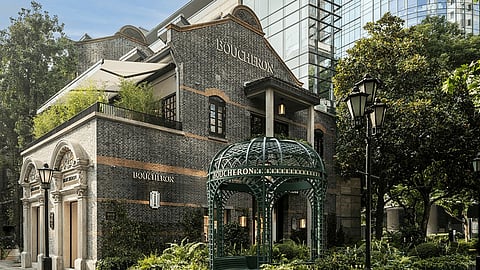

In March 2026, Boucheron inaugurated its first flagship in China in Shanghai’s historic Xintiandi district, marking its third global flagship after Place Vendôme in Paris and Ginza in Tokyo. More than a retail opening, the 278 sq. metre space is conceived as a cultural dialogue — one that connects the House’s Parisian origins with Shanghai’s layered architectural and artistic identity.
The flagship is housed within a restored 19th-century shikumen townhouse, a typology that itself reflects hybridity — where Chinese courtyard living meets Western structural influences. This architectural duality mirrors Boucheron’s own positioning: rooted in heritage yet continuously evolving.

The restoration preserves the building’s character while introducing Boucheron’s Art Deco vocabulary through symmetry, metallic detailing and geometric references, particularly the emerald cut — a signature motif. A central staircase becomes a visual axis of this exchange, lined with faceted metallic prisms in Boucheron green and Chinese red, gradually blending as one ascends.
Nature emerges as a unifying language across cultures. At the main entrance, a reinterpretation of the Place Vendôme Jardin d’hiver introduces a European conservatory structure filled with lush greenery. In contrast, the secondary entrance references classical Chinese garden design through a Moon Gate, framed by rock formations, water features and curated plant compositions. Inside, Feng Shui principles guide spatial flow, balancing light, movement and energy.
The boutique operates as a “living gallery”, where jewellery is integrated within an ecosystem of art and material expression. Installations include Xiaojing Yan’s forest of lingzhi mushrooms, concealing iconic collections such as Serpent Bohème and Quatre, alongside textile works by Huihui and ceiling art by Claire Nicolet. Additional contributions from artists such as Olga Thune-Larsen and Inkgo Lam Ka Yu introduce material diversity through straw marquetry and sculptural bamboo.
The narrative extends into the bridal space, inspired by Shanghai’s Yu Garden, and further into upper-level VIP salons, where heritage and contemporary art intersect. De Gournay wallpaper referencing Wang Ximeng’s One Thousand Li of Rivers and Mountains is juxtaposed with works by Peng Yong, creating a layered visual dialogue between past and present.
An archive room anchors the space in history, displaying pieces such as a 1923 vanity case with Chinese motifs and a 1925 powder compact featuring a peony — signalling a long-standing relationship between Boucheron and China.
The opening was accompanied by a two-part film featuring ambassadors Xiao Zhan and Zhou Dongyu, tracing the journey from Paris to Shanghai. At the inauguration, projections transformed the façade, visually bridging Place Vendôme with Xintiandi. A gala evening followed, introducing the Histoire de Style High Jewellery collection to China.
Since 2015, under CEO Hélène Poulit-Duquesne, Boucheron has steadily expanded in China, now operating 17 stores. The Shanghai flagship represents its most comprehensive expression in the market — not only as a retail environment, but as a cultural platform.
As Poulit-Duquesne notes, the opening is not a culmination but a continuation — a step towards deeper engagement, cultural exchange and long-term growth in the region.