
The Gemological Institute of America (GIA) has acquired a collection of 2,665 crystals, gemstones and mineral specimens assembled over six decades by its analytical microscopist John Koivula. The acquisition significantly expands the institute’s reference holdings, bringing together an unusual range of inclusions that offer insights into the formation, composition and internal characteristics of gemstones.
The collection documents the remarkable complexity concealed within seemingly familiar minerals. Its specimens contain inclusions of foreign minerals, trapped fluids and distinctive structural formations, some of which are rarely encountered in gemological examination.
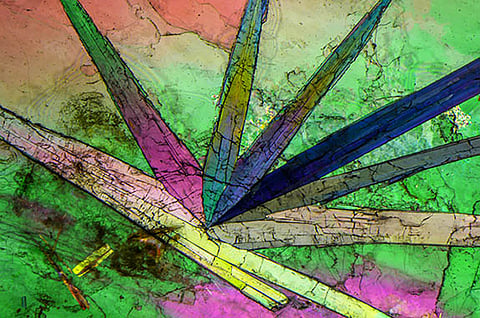
Among the notable examples are tourmaline containing fan-shaped mica formations and quartz specimens with fluorescent petroleum-fluid inclusions. These microscopic features provide valuable evidence of the geological environments and processes involved in gemstone formation.
Koivula, who joined GIA in 1976, is widely recognised for his expertise in identifying, examining and documenting gemstone inclusions. Over the course of 60 years, he developed the collection through a painstaking selection process, frequently examining hundreds of specimens to identify individual examples worthy of preservation.
According to Terri Ottaway, curator of the GIA Museum in Carlsbad, the collection represents an assemblage that would be exceptionally difficult to recreate today, given the rarity and quality of its individual specimens.
Its significance extends beyond the number of pieces acquired. The specimens collectively document the diversity of natural inclusions and the scientific information they can reveal, making the collection an important resource for gemologists, researchers and students.

Koivula’s contribution to gemology has been closely associated with the development of photomicrography, the practice of photographing minute features under magnification. His research helped establish new approaches to examining and recording the internal characteristics of gemstones.
Among his innovations was the introduction of fibre-optic illumination techniques, which subsequently became widely adopted in gemological laboratories. These methods improved the examination of inclusions, enabling specialists to study details that conventional lighting techniques could overlook.
The newly acquired collection will be catalogued in a dedicated database, making its specimens accessible as a reference resource for GIA’s educational programmes, scientific research, gemstone identification and origin services.
For GIA, the acquisition also represents an opportunity to preserve Koivula’s contribution to the discipline. Cathryn Ramirez, the institute’s senior vice president and chief learning officer, said that housing the collection at GIA would allow future generations of students, gemologists and scientists to benefit from his expertise and work.
Koivula and his colleagues are also preparing a large-format book featuring photomicrographs of specimens from the collection, bringing their intricate internal structures to a wider audience.
Selected pieces are scheduled to be exhibited at the 2027 AGTA Tucson GemFair and the Tucson Gem and Mineral Show.
By bringing together thousands of carefully selected specimens under one institutional archive, GIA is preserving more than an individual collection. It is securing a visual and scientific record of the natural features that help gemologists understand, identify and distinguish the world's gemstones.