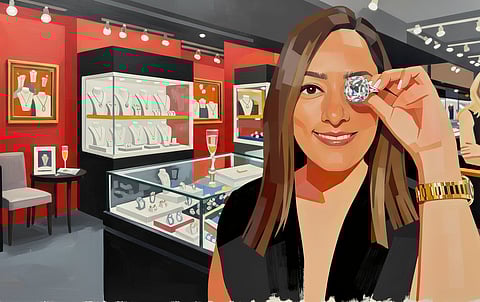

In 2025, I walked through fifteen exhibitions across eight trade shows and seven consumer shows, moving between Hong Kong, Bahrain, the United States, Italy, Saudi Arabia, Qatar, and beyond. When you experience shows this way, across formats and geographies, you stop looking for trends and start noticing patterns. What repeats subtly across markets is often more telling than what shouts the loudest.

One thing that never changes is the yearning for designs that stand the test of time. Styles evolve, proportions shift, materials are reinterpreted, but the emotional pull of classic jewellery remains constant. What felt different in 2025 was how jewellery is increasingly worn as a form of self-ex- pression. Layering, stacking, charms, and personal com- binations were everywhere, not as styling tricks but as intentional choices. Jewel- lery today feels less about making a single statement and more about how pieces coexist over time.
The Middle East continues to stand apart in the caliber of the jewels on display. The scale, rarity, and confidence of presentation are unmatched. That has always been true. What surprised me this year was Qerat in Kuwait. As a debut show, it felt impactful and intention- al, with a clear understanding of its audience. There was no need for excess. The jewels carried the narrative themselves, which made the experience feel refreshingly focused. Gold prices were impossible to ignore in 2025. The volatility caught many by surprise and accelerated conversations that had previously felt peripheral. For years, alternative metals were largely the territory of design houses that prided themselves on doing things differently. This year, it has become a practical consider- ation across the industry.
Titanium, carbon fiber, osmium, bronze, silver, and platinum appeared with increasing frequency, not as novelty, but as thoughtful responses to economic reality. What interested me was not the materials themselves, but how quickly the industry adapted when necessity demanded it.
Trends come and go, as they always do. What consistently resonated with buyers was versatility and quality. Pieces that could move with the body, transform, or adapt to different contexts held attention longer. Movement is becoming integral to jewellery design, not for spectacle, but for intimacy. A jewel that moves invites conversation. It asks to be worn, not just admired.
Buyer literacy remains rooted in the classics. Even as younger consumers enter the market, their reference points are still timeless cuts, recognisable benchmarks of quality, and materials that have proven themselves over decades. Provenance has become central to these conversations, particularly around natural diamonds and coloured gemstones. People want to understand where a stone comes from, how it was sourced, and what that story adds to the piece beyond beauty.
This shift made me more sensitive in my own work. In 2025, I made a conscious effort to include provenance whenever possible. To me, quality today is defined by three things working together: craftsmanship, rarity, and storytelling. Remove one, and the piece feels incomplete.
Generational differences were also more pronounced. Gen-Z is still finding its footing. For them, jewellery is primarily a form of self-expression rather than investment or legacy. Millennials are entering a stage where they can afford to indulge in higher-ticket pieces and more significant acquisitions. Established collectors are focused almost exclusively on rarity, on jewels that cannot be easily replicated or replaced. Walking shows with this lens made it clear that no single narrative can speak to all audiences, and brands that try often dilute their messages.
The conversation around lab-grown versus natural diamonds was constant, as were discussions about gold pricing. What stood out was not polarisation, but fatigue. Buyers are not looking to be persuaded. They want clarity. They want to understand what they are buying, why it is priced the way it is, and what value means long-term. Brands that communicated transparently, without absolutes, felt far more credible than those leaning on simplified claims. Storytelling has also evolved. In 2025, fewer brands relied on grand narratives delivered all at once. Instead, stories were woven quietly into presentation, through display, language, and pacing. This approach feels more aligned with how people consume information today. Subtlety builds trust.
Personally, 2025 sharpened my perspective. I found myself asking different questions, listening more closely, and placing greater value on intention over performance. The volatility of gold prices and the ongoing lab-grown conversation were both moments of recalibration. They forced the industry to confront assumptions and adapt quickly, revealing which brands had depth beneath the surface.
If there is one thing I will carry into 2026, it is this. Jewellery that endures is not defined by novelty or noise. It is defined by clarity of purpose, respect for material, and an understanding of the wearer. After a year of walking shows across markets and formats, what stayed with me were not the loudest pieces, but the most thoughtful ones. Those are the signals worth paying attention to.