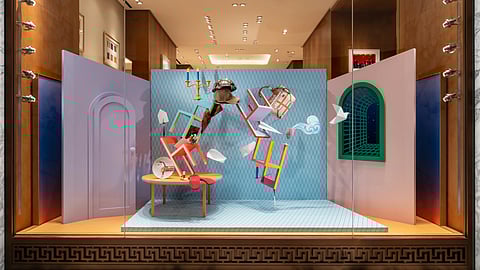

Hermès has turned the store window into something far larger than a display: it is a universe in miniature, where mood, craft, and imagination meet. For jewellers, these windows offer lessons in how atmosphere can shape desire. They show how even the smallest object can become magnetic when framed with intention. And they reveal why storytelling, not sparkle, is what truly stops someone on the street.

Hermès windows as poetic spaces where craft, fantasy, and emotion converge
Hermès has long treated its windows as poetic spaces where craft, fantasy, and emotion converge. For jewellers, these brief moments on the street offer a powerful lesson in how visual storytelling can transform even the smallest object into a scene of desire.
The window as an aperture into a universe, not a frame
Inside the world of Hermès, a window is never merely a glass framing a product. It is an aperture into a universe that is sometimes unusual and contemplative, but always composed with intention. It uses a quieter kind of theatre, one that draws meaning from atmosphere and suggestion. For jewellery retailers who often depend on a piece's inherent sparkle to convey value, this approach offers a different logic: the window becomes a story, a stage on which the object acquires life and emotional presence, attracting the person passing by.
The importance of narrative and avoiding static presentation
Hermès avoids static presentation. Every window suggests a moment paused in time. A silk scarf may lift in an imagined breeze, a saddle might inhabit a dreamlike landscape. This sense of narrative transforms the passer-by from an observer into someone who feels invited into the scene. Especially for jewellers, this shift is vital. When the display carries purpose, even the smallest ring or pendant gains significance. A jewel placed within a sculptural vignette or presented with a hint of storytelling becomes part of an unfolding moment rather than just a product arranged for sale.
Minimalism and the discipline of editing
Minimalism is equally central to Hermès' philosophy. Though the tableaux often feel rich, they are edited with discipline. Negative space is treated as an active design element, giving the object room to breathe and assert itself. Jewellery, which can easily be overwhelmed by visual noise, benefits immensely from this approach. Restraint sharpens perception. A window that feels focused and uncluttered does more than highlight the object; it creates an emotional rhythm that allows the viewer to imagine and connect.
Mood, colour, texture, and lighting as emotional triggers
Mood is another hallmark of Hermès’ visual language. Before the eye identifies a single item, the viewer feels something: warmth, calm, intrigue, or play. Moreover, colour is chosen with intention, texture with sensitivity, and lighting with emotional purpose. Leïla Menchari, the visionary behind many of the house’s most iconic windows, understood that atmosphere operates on a subconscious level. Therefore, a jeweller who selects a palette for its emotional resonance rather than for seasonal convention instantly shifts the window decoration to evocative. Lightning deepens this effect, a warm tone invites intimacy, while a cooler one sharpens modernity. When colour, light, and material harmonise, the window becomes a sensory statement in attracting potential consumers.
Metaphor and abstraction instead of literal storytelling
Part of Hermès’ enduring magic is its ability to hint at an entire world without relying on literal storytelling. Instead of staging direct themes, the brand shapes environments built on metaphor and abstraction. A single sculptural form may echo a curve, a movement, or a material associated with the product. Faint motifs often reappear across windows, quietly stitching them into a cohesive universe. For jewellers, this presents an opportunity to build a visual identity that extends beyond the standard tray or bust. A recurring colour, a signature texture, or a distinctive silhouette can create a vocabulary through which the brand speaks fluently and recognisably.
Surprise and subtle delight as tools to spark curiosity
Surprise also plays a crucial role. Hermès often introduces gentle moments of delight, a shift in scale, a reflective surface, a concealed detail that rewards closer attention. These elements encourage curiosity without overpowering the product. Jewellery can benefit from similarly understated intrigue. A mirrored plane that reveals the under gallery of a ring, a shadow that echoes the geometry of a pendant, or a profound kinetic element that can draw the viewer closer and create a sense of discovery.
Craftsmanship as the quiet centre of the window
Throughout all of this, craftsmanship remains at the centre; Hermès rarely declares it outright, yet every decision in the window, its composition, angle, texture, or lighting, quietly points back to the maker’s hand. A buckle might be positioned to highlight the precision of its curve; a scarf may be arranged to reveal the depth of its print. For jewellers, this offers a meaningful insight: craft communicates most powerfully through thoughtful framing rather than literal explanation. A jewel positioned to reveal the edge of a setting or the architecture of a shank allows the craftsmanship to speak in its own language.
Intention over saturation: elevating a small jewel into an object of longing
In an industry increasingly shaped by visual saturation, Hermès demonstrates the value of intention. Its windows show that theatre can be gentle, luxury can be quiet, and storytelling can be achieved without excess. When the display becomes a world to step into rather than a surface to look at, a small jewel transforms into an object of longing. For jewellers ready to approach their windows as landscapes of emotion and imagination, the possibilities expand.
The piece remains the hero, but the world surrounding it finally elevates it to the realm of desire.