For more than a century, De Beers has been synonymous with the natural diamond trade. It shaped consumer desire, controlled global supply and helped transform a geological rarity into one of the world's most enduring luxury products. Today, however, the company finds itself confronting a challenge it cannot solve simply by withholding supply.
Its decision to suspend production for two years at the Venetia mine in South Africa—its largest operation by output—is not merely another cost-cutting exercise. It is the clearest acknowledgement yet that the natural diamond business is undergoing a structural reset.
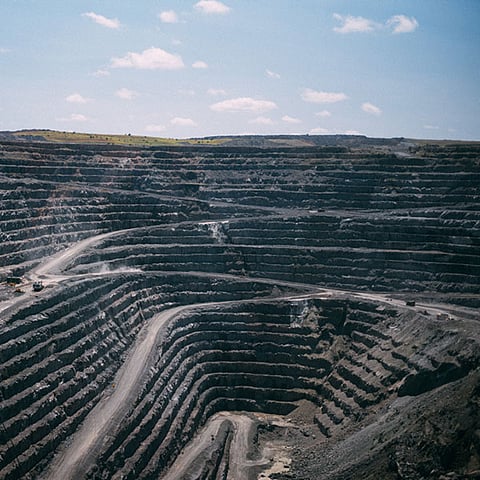
Venetia, located in Limpopo province, accounts for roughly 40 per cent of South Africa's diamond production and around a tenth of De Beers' global output. After years of investment to transition the operation from an open pit to an underground mine, it was expected to remain productive well into the 2040s. Instead, production will now be paused while the company continues maintaining underground infrastructure, waiting for market conditions to improve.
Demand Has Changed Faster Than Supply
The diamond industry has always been cyclical. Periods of exuberant demand have routinely been followed by inventory corrections and production cuts. Yet the current slowdown is proving unusually persistent because it is being driven by several forces at once.
China, once expected to become the industry's second engine of growth after the United States, has failed to regain its pre-pandemic appetite for luxury spending. Consumer confidence remains fragile, discretionary purchases have slowed and jewellers continue to report subdued footfall.
Even in the United States, where demand has proved relatively resilient, consumers have become noticeably more selective. Inflation, higher interest rates and changing spending priorities have softened purchases of high-value luxury goods, including natural diamonds. Meanwhile, the rise of laboratory-grown diamonds has permanently altered the competitive landscape.
What began as a niche category has become a meaningful competitor in parts of the diamond market. Falling production costs have made lab-grown diamonds increasingly accessible, particularly in price-sensitive segments. While natural diamonds continue to dominate the luxury end of the market, the emergence of an alternative has reshaped purchasing patterns for some consumers. The challenge for the industry is therefore not demand alone, but demand that is becoming more segmented.

Historically, De Beers responded to market weakness by restricting the flow of rough diamonds into the market. Supply management became one of the company's defining strengths, helping stabilise prices during periods of oversupply.
That strategy still has value, but it has become considerably less powerful. Unlike previous downturns, today's market is not suffering solely from excess inventory. It is also wrestling with evolving consumer preferences and a rapidly expanding supply of competing products that traditional production cuts cannot control.
Suspending Venetia therefore serves two purposes. It immediately lowers operating costs while preventing additional rough diamonds from entering an already oversupplied market. Yet it also reflects an uncomfortable reality: producers can reduce supply, but they cannot manufacture demand.
The timing is awkward for Anglo American, De Beers' parent company. As part of its broader restructuring, Anglo has been attempting to divest its diamond business and concentrate investment on commodities such as copper that are expected to benefit from electrification and the global energy transition.
Selling a diamond company, however, becomes considerably more complicated when diamond prices are under sustained pressure. Repeated impairments have reduced De Beers' valuation, while potential buyers face uncertainty over how quickly the natural diamond market will recover. Venetia's temporary suspension may improve short-term cash preservation, but it also reinforces the perception that the industry's recovery remains some distance away.
Behind every production decision lies a workforce. Venetia supports thousands of direct and indirect jobs across Limpopo, making it one of the region's largest industrial employers. Labour representatives have warned that more than 1,000 jobs could ultimately be affected, with consultation processes already underway.
Although De Beers has stressed that the production pause is temporary and that underground development work will continue, communities dependent on the mine face an extended period of uncertainty. For South Africa, where mining remains a critical employer despite decades of economic diversification, the decision carries significance well beyond the diamond industry.
An Industry Searching for Its Next Chapter
The challenges confronting natural diamonds are no longer simply about price. For decades, the industry's competitive advantage rested on scarcity. A natural diamond was valuable because nature made it rare.
Laboratory-grown diamonds have complicated that narrative. While they have not diminished the geological rarity of natural stones, they have weakened scarcity as a commercial proposition. Consumers now have a credible alternative that satisfies many of the same emotional and aesthetic needs at substantially lower prices.
That leaves the natural diamond industry facing a more fundamental question: how should it justify its premium? Increasingly, the answer lies not in geology but in storytelling—heritage, provenance, craftsmanship, sustainability and emotional significance. De Beers has responded with renewed investment in category marketing and traceability initiatives, hoping to reinforce the distinction between natural and laboratory-grown stones.
Whether those efforts can reverse shifting consumer behaviour remains uncertain.
Venetia's suspension is unlikely to define De Beers' future. The company retains a portfolio of world-class assets, an unmatched heritage and considerable influence over the global diamond trade.
Yet the decision may come to define this moment. For much of the twentieth century, De Beers shaped the diamond market. Today, the market is reshaping De Beers. That inversion captures the industry's predicament. Cyclical downturns eventually end. Structural transformations do not. The temporary silence at Venetia is therefore less a pause in production than a reminder that the economics of natural diamonds are being rewritten—and that even the industry's most powerful player must now adapt to forces it no longer fully controls.