
When Valérie Messika founded her eponymous Maison twenty years ago, she was entering a category that had, for the better part of a century, belonged to a small handful of heritage names — houses with archives, ateliers and codes established long before she was born. Rather than compete on their terms, she chose not to.
"From the beginning, I knew that if I followed the same codes as the heritage Maisons, Messika would have no reason to exist," she says. The strategy, as she describes it, was inherited rather than invented. "My father gave me two pieces of advice: to be different, to never copy, and to remain focused on diamonds, because that was our family expertise. I built the Maison around those two principles."
That focus produced a category of its own — diamond jewellery filtered through the vocabulary of fashion rather than heirloom tradition. The pieces that emerged were deliberately light, wearable and built for daily rotation rather than the vault. In time, the same instinct migrated upward into High Jewellery, a category the Maison approached with the same insistence on movement and ease. "We approached diamond jewellery through the lens of fashion and created pieces that were light, comfortable and designed to be worn every day," she says. "Later, we brought that same philosophy into High Jewellery, with pieces that are exceptional in craftsmanship but still modern, versatile and connected to the body. This consistency has helped us build a very clear identity."
"My father gave me two pieces of advice: to be different, to never copy, and to remain focused on diamonds, because that was our family expertise. I built the Maison around those two principles."

A generational shift in how women wear diamonds
Messika's arrival coincided with — and arguably helped accelerate — a broader recalibration of what diamonds are for. Two decades ago, the stone's cultural grammar was largely fixed: special occasions and gifting. Messika set out to dismantle that grammar entirely.
"The relationship with diamonds has changed enormously," she says. "When I started Messika, twenty years ago, diamonds were still strongly associated with engagements, weddings and important gifts for special occasions. I wanted to change that relationship and encourage women to buy diamonds for themselves and wear them every day."
The shift she describes today is one of fluency rather than formality. "Today, clients want more freedom. They mix jewellery, stack pieces and wear diamonds with jeans or a simple white shirt. They are also looking for design and personality, not only the intrinsic value of the stone." She calls it "a very positive evolution," one rooted in a simple premise: "jewellery should be part of your life and reflect who you are."
"When I started Messika, twenty years ago, diamonds were still strongly associated with engagements, weddings and important gifts for special occasions. I wanted to change that relationship and encourage women to buy diamonds for themselves and wear them every day."
Craftsmanship as a living, not archival, practice
For a Maison built on breaking with heritage codes, Messika's relationship to French savoir-faire remains, paradoxically, deeply traditional in execution if not in spirit. The house maintains its own High Jewellery atelier in Paris, where savoir-faire is preserved even as the output is pushed forward.
"For me, craftsmanship and modernity are not opposites," she explains. "We have our own High Jewellery atelier in Paris, where exceptional techniques and traditional savoir-faire are preserved, but we use them to create pieces that belong to today."
Her reference points sit deliberately outside the jewellery world. "I am constantly inspired by fashion, architecture, art, music and the women around me. This influences everything from the way I design a piece to the way we present High Jewellery." That instinct led Messika to stage its High Jewellery through runway presentations rather than private salon viewings — an approach that was unconventional when the house first adopted it. "We were among the first jewellery Maisons to present High Jewellery through a real runway show, because I wanted the pieces to be seen in movement, styled on the body and connected to the culture of the moment. The craftsmanship is deeply French, but the attitude is contemporary."
Reading the Indian client
Messika's engagement with India comes with a clear-eyed appreciation of a market that combines depth of jewellery knowledge with genuine appetite for newness. "What stands out to me is the extraordinary knowledge of jewellery in India," she says. "Indian clients understand stones, craftsmanship and the emotional value of a piece. There is a real culture of jewellery that is passed from one generation to another."
Alongside that inherited fluency, she identifies a younger cohort writing its own rules. "I see a younger generation developing its own relationship with jewellery. They are very informed, internationally connected and interested in pieces that express their personal style. This combination of deep jewellery knowledge and a desire for contemporary design is what makes India particularly exciting for Messika."
"I see a younger generation developing its own relationship with jewellery. They are very informed, internationally connected and interested in pieces that express their personal style. This combination of deep jewellery knowledge and a desire for contemporary design is what makes India particularly exciting for Messika."
Desirability, built on authenticity rather than proximity to fame
Messika's rise has often been narrated alongside its celebrity affiliations, but the founder is careful to draw a line between visibility and genuine cultural resonance. "They play an important role, but only when the connection feels authentic," she says of celebrity and red-carpet exposure. "For me, seeing a woman choose to wear Messika is powerful because she brings her own personality and attitude to the jewellery."
She points to a single moment as pivotal to the Maison's international recognition. "Beyoncé was an important moment for the Maison because she chose to wear Messika at a time when we were still a young brand internationally. Moments like this can introduce the Maison to a much wider audience."
But Messika is emphatic that fashion, not fame, has been the more enduring creative partner. "Our relationship with fashion goes beyond celebrity visibility. Fashion has always been part of my creative process, from collaborations with Gigi Hadid and Kate Moss to our High Jewellery shows during Paris Fashion Week. I want jewellery to be styled, layered and worn with attitude." The distinction she draws between the two channels is precise: "The red carpet creates dreams, while fashion shows another way of living with the pieces. Both are important to building desirability today."
"Beyoncé was an important moment for the Maison because she chose to wear Messika at a time when we were still a young brand internationally. Moments like this can introduce the Maison to a much wider audience."
Terres de Contrastes: a chromatic journey through Botswana
That same instinct — for movement, for narrative, for jewellery drawn from life rather than the vitrine — animates Messika's newest High Jewellery statement. "Terres de Contrastes" takes flight above the untamed expanse of Botswana, a land the Maison describes as one of sovereign contrast, its terrain in perpetual renewal. It is a geography rendered in colour: the Okavango Delta flowing in deep blue and green, the Kalahari Desert burning red and ochre, and the Makgadikgadi salt pans stretching white and pure as dusk surrenders to rose and violet.
"In my mind, three words rule this collection: power, colour, and life," says Valérie Messika. "Power, because the landscapes themselves command it. Colour, because Botswana summons its own all-governing light. And life, because every piece strikes its own vital rhythm; the heartbeat of a nation jewelled by the beauty of contrast."
Colour first entered the Maison's Haute Joaillerie vocabulary with 2025's "Terres d'Instinct," a tribute to Southern Africa that marked a departure from the Maison's once diamond-exclusive legacy. "Terres de Contrastes" extends that chromatic vision further, moving from the desert dunes of Namibia to the grasslands of Botswana. Colour, here, functions as a vibration of light — gemstone and diamond held in exalting communion, the Maison's savoir-faire translating that creative impulse into form, colour and craft. Three chromatic territories, each drawn from a distinct Botswana landscape, structure the collection.
The Okavango Delta
A river that never reaches the sea, the Okavango travels thousands of kilometres across Southern Africa before losing itself in the Kalahari Desert, fanning out instead into an interior paradise of branching waterways, floating islands and deep blue lagoons.
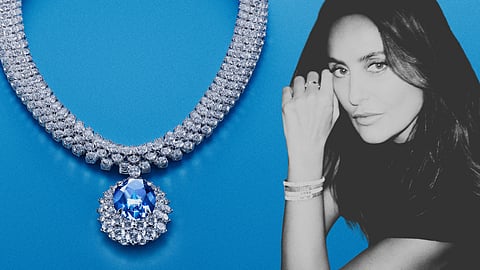
Its centerpiece, Le Okavango Blue necklace, marks a landmark partnership between Messika and the Government of Botswana. The stone at its heart — discovered in 2018 at the Orapa Mine — is the largest and rarest blue diamond ever to emerge from Botswana: 41.11 carats in its rough state, polished to 20.46 carats and classified Fancy Deep Blue. Its setting into jewellery by Valérie Messika is a first for the stone. More than 500 diamonds trace a serpentine path around the neck, their play of light echoing the shifting reflections of the Okavango's waters, with the central stone suspended low against the chest.
Elsewhere in the Delta grouping, Delta Sacré renders the region's aerial cartography — channels braiding blue through green, islands and floodplains at the water's mercy — into jewel form. Féroce, meanwhile, takes its cue from the crocodile rising from the Okavango's shadowed depths, its sharp, triangular volumes of gold evoking a serrated line of teeth, primal and graphically refined. Règne draws on the Kalahari's other apex predator, the feline, articulated through flush-set onyx reimagined as spots and footprints — a nod, the Maison notes, to Valérie Messika's own safari memories — anchored by a center stone in Fancy Deep Brownish Yellow, its warmth echoing the sun-drenched earth beneath it.
"In my mind, three words rule this collection: power, colour, and life. Power, because the landscapes themselves command it. Colour, because Botswana summons its own all-governing light. And life, because every piece strikes its own vital rhythm; the heartbeat of a nation jewelled by the beauty of contrast."
The Kalahari Desert
Beyond the Delta's lush interior, the Kalahari burns beneath a blistering sun — red sands shifting, golden savannahs stretching to the horizon, light itself defining the vastness of the terrain. It is, in the Maison's telling, a territory of unrelenting heat, its chromatic world built from fiery ochre and molten orange, where the sun alone rules the arid realm.
Messika frames "Terres de Contrastes" as a marker of transition rather than a finished statement. Rooted in Botswana's majestic terrain, the collection fuses the primal dualities of delta, desert and salt pan into a single, fluid, fiercely alive chromatic vision — one the Maison will expand upon this October, when the narrative continues at the Messika Haute Joaillerie runway show during Paris Fashion Week.
It is, in many ways, the clearest expression yet of the philosophy Valérie Messika has pursued since her earliest days at the Maison: that a diamond house need not inherit its codes to command respect — it can write its own, in colour, in movement, and increasingly, across continents.