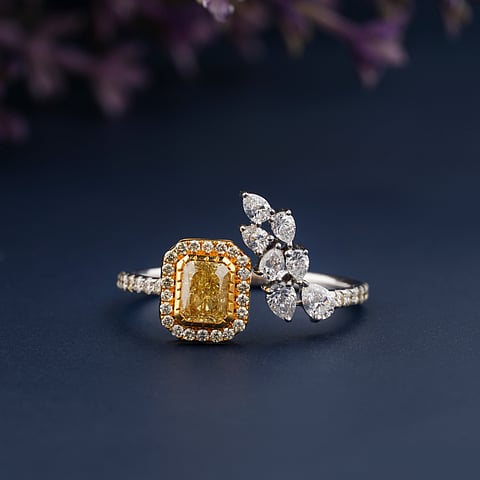

For decades, diamonds have been synonymous with colourlessness—a celebration of purity, brilliance and perfection. But the luxury landscape is changing. Today's consumers are increasingly seeking individuality over uniformity, and nowhere is this shift more visible than in the rising interest in natural fancy colour diamonds.
Once reserved primarily for elite collectors and auction rooms, fancy colour diamonds are gradually becoming an important part of high jewellery collections, retail assortments and investment conversations. From vivid pinks and prestigious blues to commercially accessible yellows, colour is redefining how the industry understands rarity.
According to industry experts, the growth is being driven by a combination of greater consumer awareness, evolving design preferences and a renewed appreciation for gemstones that possess an intrinsic story.
The past two years have seen a significant evolution in demand across fancy colour categories. While yellow diamonds continue to dominate commercial conversations due to their relative accessibility, pink and blue diamonds are attracting growing interest because of their rarity and investment appeal.
"Yellow diamonds continue to anchor the commercial market, but demand for pinks—particularly Fancy Intense and Fancy Vivid Pink—is growing rapidly as retailers look for true points of differentiation," says Ankita Kothari of Anan Jewels India. "Blue diamonds remain highly aspirational, though their rarity naturally limits availability, while green diamonds continue to appeal to a niche collector audience."
She believes the biggest transformation is not merely in which colours consumers prefer, but how they perceive colour diamonds themselves. "Natural fancy colour diamonds are no longer reserved for one-off statement pieces; they are becoming an integral part of curated collections," she explains.

Harsh Maheshwari of Kunming Diamonds in Hong Kong has observed a similar shift, particularly at the highest end of the market. "Demand has been selective but resilient," he says. "Pinks and blues continue to lead with strong double-digit gains in the vivid and intense grades. Pinks have especially benefited from the post-Argyle scarcity narrative. While commercial yellow diamonds softened before stabilising, top Fancy Vivid canary yellows continue to hold firm. Green and orange diamonds have pockets of strong collector interest, while purple and violet diamonds remain exceptionally niche and command significant premiums whenever they appear."
This evolution is also evident in India, where awareness of fancy colour diamonds is expanding beyond traditional collectors. Denish Shah of D'Diam observes that larger yellow and pink diamonds are witnessing increasing demand as consumers become more familiar with the category and begin incorporating them into jewellery.
Nandinee Kakadiya, Head of Jewellery Division at Surat’s SKSM Diamond Impex Ltd. adds that pink and blue diamonds have particularly strengthened their position as value-driven assets. "Pink and blue diamonds have significantly outperformed other colours in terms of value appreciation and investor interest," she says. "For the Indian market, yellow diamonds are moving faster because of their comparatively affordable pricing."
Unlike white diamonds, where supply chains can be relatively predictable, natural fancy colour diamonds operate within the limitations of geology. Their rarity is not created by market strategy but by nature itself.
For manufacturers, sourcing exceptional stones remains one of the industry's greatest challenges—particularly when consistency of colour, saturation and size is required. "At Anan Jewels India, we have built long-standing sourcing relationships over many years, which is essential in a category where consistency is difficult to achieve," says Kothari. "The real challenge today is not simply acquiring exceptional stones, but maintaining continuity across colours, sizes and matching pairs while global demand continues to rise."
Maheshwari believes those challenges have intensified over the past decade. "Manufacturers now face longer lead times, greater provenance scrutiny and much higher competition for the best rough," he says. "The biggest challenge today is consistency—securing steady inventory of saturated material at digestible prices. An end-to-end supply chain has become far more important today than it was a decade ago."
For SKSM, the complexity lies not only in sourcing stones but also in transforming them into finished jewellery.
"Fancy colour diamonds are available in very limited quantities, but pink and blue diamonds are extremely rare," says Kakadiya. "As manufacturers of natural fancy colour jewellery, we face challenges in matching the intensity and saturation of colour. Producing a single piece can take a considerable amount of time."
Not everyone, however, sees supply as an immediate concern. Denish believes the current availability of fancy colour diamonds remains relatively stable, noting that "supply is not a big problem for fancy colours as of now."
While the US and Europe remain established markets for fancy colour diamonds, demand is becoming increasingly diversified.
"The US and Europe continue to be mature markets for natural fancy colour diamonds, with strong demand for bespoke and design-led jewellery," says Kothari. "East Asia remains highly selective, placing significant emphasis on rarity, provenance and long-term value."
She adds that the Middle East has emerged as an important growth market, while India itself is undergoing a transformation. "As consumer tastes become more sophisticated, natural fancy colour diamonds are moving beyond a niche category and becoming a meaningful avenue for self-expression."
Maheshwari is also witnessing growing momentum across regions. "Asia is gradually recovering and we're seeing collectors return for important stones," he says. "Beyond China, the Indian market has been thriving too. The US remains the key market across every segment—from commercial goods to exceptional investment stones. The Desert Diamonds campaign is now present across more than 2,000 points of sale, which says a great deal about the growing consumer appetite."
D'Diam likewise identifies the US and India as key growth markets, while SKSM highlights the US, the Middle East and India as important centres of consumption. Nandini believes changing economic conditions are also influencing buying behaviour, with consumers increasingly viewing diamonds as a store of value amid fluctuations in gold prices.
Perhaps the most significant shift is the changing profile of the buyer. Historically dominated by collectors and ultra-high-net-worth individuals, fancy colour diamonds are increasingly attracting younger consumers who view jewellery as an expression of identity.
"The younger generation are more interested in fancy colour diamonds as of now," says Denish, reflecting a broader shift in luxury consumption.Maheshwari agrees, but believes the market is benefiting from both old and new collectors. "Seasoned collectors still write the big cheques, but younger buyers are crashing the party," he says. "They want a stone that feels personal and unique. It's a healthy mix."
Kothari has observed a similar evolution among Indian retailers, particularly as younger generations take over family jewellery businesses. "They are looking beyond traditional merchandising and actively seeking products that help define their identity in an increasingly competitive market," she explains. According to her, this new generation is not simply buying a gemstone—it is looking for a narrative. "Natural fancy colour diamonds have become an important part of that conversation, allowing retailers to create collections that feel distinctive rather than interchangeable."
Nandini echoes this sentiment, noting that younger consumers are increasingly embracing fancy colour diamond jewellery, making it a defining element of contemporary luxury.
The growth of lab-grown diamonds has transformed access to coloured diamonds, making vibrant hues available at significantly lower price points. Yet industry leaders are unanimous in their belief that natural fancy colour diamonds occupy an entirely different position within the luxury landscape.
"Lab-grown diamonds have undoubtedly disrupted the industry, particularly by making colour more accessible at lower price points," says Kothari. "However, when it comes to natural fancy coloured diamonds, the customer investing in a natural pink, blue or yellow diamond is not simply buying colour—they are buying rarity."
She believes increased accessibility through technology may actually strengthen the appeal of natural stones. "The more accessible lab-grown colours become, the more the rarity of natural fancy colour diamonds is appreciated."
Denish maintains that the two categories cater to fundamentally different customers. "Both are completely different markets, and those who are into the natural fancy colour market are not entertaining lab grown," he says.
Maheshwari sees the distinction in even broader terms. "Natural fancy colours remain the domain of collectors, connoisseurs and investors who value geological rarity, provenance and the emotional weight of a one-of-a-kind natural treasure," he says. "The two categories coexist—one democratises luxury and colour, while the other preserves true rarity. Smart buyers understand the distinction, and natural diamonds remain both an asset class and an heirloom."
Nandini agrees that while laboratory-grown diamonds are influencing the broader diamond market, ultra-luxury consumers continue to value authenticity above all else. "Natural fancy colour diamond buyers are looking for rarity and exclusivity, so that does not affect the category," she says.
As luxury consumers increasingly prioritise authenticity, individuality and enduring value, natural fancy colour diamonds appear well positioned for sustained growth. Their appeal extends beyond aesthetics; it is rooted in geological scarcity, provenance and the assurance that no two stones are exactly alike.
For the jewellery industry, the opportunity extends far beyond introducing more colour into collections. Fancy colour diamonds represent a broader evolution in luxury itself—one where rarity, emotional resonance and long-term value increasingly outweigh conventional ideas of perfection. In an era where technology can replicate almost everything, nature's rarest colours remain impossible to imitate, making them some of the most compelling treasures in contemporary high jewellery.