
The Kimberley Process was designed for a far simpler world. When the diamond certification scheme was established in 2003, its purpose was specific and politically urgent: preventing rebel groups in African war zones from financing insurgencies through rough diamond sales. The system emerged from the civil conflicts of Sierra Leone, Angola, and Liberia, when “blood diamonds” became shorthand for the human cost of unregulated extraction.
Two decades later, the diamond trade faces a different crisis entirely. Wars are now interstate. Supply chains are globalised and opaque. Sanctions increasingly shape commodity flows. Consumers demand traceability as a baseline expectation. Lab-grown diamonds are reshaping pricing structures and luxury perception. And the industry’s largest manufacturing hub—India—now finds itself at the centre of those overlapping pressures.

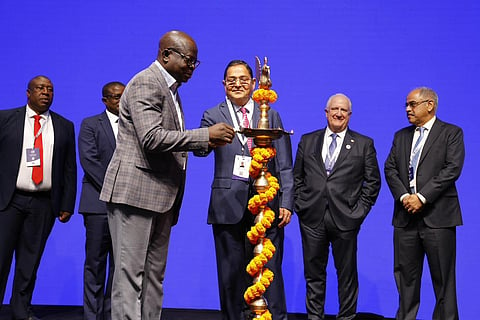
India’s assumption of the 2026 chairmanship of the Kimberley Process arrived at a moment of mounting scrutiny for the global diamond trade. Against that backdrop, the KP Dialogue Forum, held at Mumbai’s Jio World Convention Centre on 10 May 2026 ahead of the Kimberley Process Intersessional Meeting, became less a ceremonial gathering and more an attempt to redefine the industry’s strategic language around legitimacy, transparency, and trust.
Established under United Nations mandates, the Kimberley Process Certification Scheme was created to prevent conflict diamonds—rough diamonds used to finance armed insurgencies against recognised governments—from entering legitimate global supply chains. Today, the framework includes 60 participants representing 86 countries, with the European Union and its member states counted as a single participant. Collectively, the system governs more than 99% of the world’s rough diamond trade.
India’s appointment as chair for 2026 marks the third time the country has led the body. The symbolism is significant. India imports and processes the overwhelming majority of the world’s rough diamonds by volume, while Surat and Mumbai remain among the industry’s most influential manufacturing and trading centres.
The Mumbai forum was organised around what officials termed the ‘3Cs Initiative’— Credibility, Confidence and Compliance—themes that increasingly define the natural diamond industry’s survival strategy.
Opening the proceedings, Kirit Bhansali, Chairman of the Gem & Jewellery Export Promotion Council (GJEPC), framed India’s leadership in institutional terms. “India’s selection reflects the international community’s trust in India’s principled and inclusive approach,” he said, adding that the country’s chairmanship would focus on governance, transparency, and cooperation across the global diamond trade.From Conflict Diamonds to Consumer Distrust
What became apparent throughout the forum was that the Kimberley Process is no longer merely attempting to regulate conflict diamonds. It is now attempting to preserve confidence in natural diamonds themselves.
That distinction matters.
The original Kimberley framework was built around a narrow legal definition focused on rebel-financed violence. But the industry now faces broader reputational questions involving sanctions, environmental scrutiny, ethical sourcing, and technological verification. The rise of laboratory-grown diamonds has only intensified those anxieties by offering consumers a product marketed as simpler, cleaner, and easier to explain.
Several speakers acknowledged that the natural diamond industry has struggled to adapt its messaging to younger luxury consumers, who increasingly expect auditable sourcing histories rather than broad assurances from brands.
What became apparent throughout the forum was that the Kimberley Process is no longer merely attempting to regulate conflict diamonds. It is now attempting to preserve confidence in natural diamonds themselves.That distinction matters.
The original Kimberley framework was built around a narrow legal definition focused on rebel-financed violence. But the industry now faces broader reputational questions involving sanctions, environmental scrutiny, ethical sourcing, and technological verification. The rise of laboratory-grown diamonds has only intensified those anxieties by offering consumers a product marketed as simpler, cleaner, and easier to explain.
Several speakers acknowledged that the natural diamond industry has struggled to adapt its messaging to younger luxury consumers, who increasingly expect auditable sourcing histories rather than broad assurances from brands.
The forum’s first major discussion, “Credibility: The Power of Communication in Earning Credibility”, examined the natural diamond industry’s deteriorating narrative power in an era shaped by algorithmic marketing and synthetic alternatives.
The panel brought together Feriel Zerouki, the outgoing President of the World Diamond Council; James Doran, Chair of the Kimberley Process for 2025 and senior official at the United States Department of State; Anoop Mehta, President of the Bharat Diamond Bourse and Chairman & Managing Director of Mohit Diamonds Pvt. Ltd.; alongside representatives from the retail and communications sectors.
Zerouki argued that transparency could no longer function as a secondary industry concern. “Consumers today expect authenticity, traceability, and proof,” she said during the session, stressing that trust in natural diamonds now has to be actively earned rather than historically assumed.
Doran emphasised the importance of institutional co-ordination within an increasingly fragmented geopolitical environment, particularly as governments and markets adopt differing approaches to sanctions and sourcing standards.
Mehta, meanwhile, pointed to India’s central role within the global supply chain, arguing that the country’s manufacturing ecosystem would remain critical to any future traceability architecture adopted by the trade.
The second session, “Confidence: Current State of Market Demand and Consumer Protection”, shifted towards retail behaviour and changing luxury consumption patterns. Moderated by Russell Mehta, Managing Director of Rosy Blue India, the panel included executives and representatives linked to Titan Company, De Beers Group, the Natural Diamond Council, and the Gemological Institute of America (GIA).
Discussion repeatedly returned to the issue of consumer scepticism. Panellists noted that younger buyers increasingly expect granular origin disclosure, particularly as luxury purchasing becomes more values-driven and digitally informed. Several participants also addressed the growing competitive pressure posed by lab-grown diamonds, particularly within entry-level bridal and fashion jewellery categories.
The forum’s final session, “Compliance: Beyond Compliance — From Traceability to Trust”, reflected the industry’s accelerating turn towards technology-led verification systems. Participants included representatives from Alrosa, Tracr, Everledger, and Sarine Technologies, with discussion centred on blockchain-backed traceability, tamper-proof certification systems, and digital tracking tools that could eventually replace much of the paper-heavy verification architecture historically associated with the Kimberley Process.
The underlying argument was clear: future legitimacy within the diamond trade may depend as much on data infrastructure as geological rarity.India’s Strategic Balancing Act
India’s chairmanship arrives at a commercially delicate moment.
Russian rough diamonds remain important to India’s manufacturing supply chain, particularly within Surat’s small-stone processing sector. At the same time, India’s largest export markets—especially the United States and Europe—increasingly demand tighter compliance standards and more sophisticated origin verification. That leaves India attempting to reconcile conflicting commercial interests while preserving consensus within the Kimberley Process itself.
In his concluding remarks, Saket Kumar, senior adviser to India’s KP chairmanship and Joint Secretary in the Ministry of Commerce and Industry, stressed the need for the Kimberley Process to evolve alongside changing market expectations while remaining commercially workable for producing, manufacturing, and trading nations alike.
Behind the forum’s diplomatic language, however, the underlying message in Mumbai was more direct: the natural diamond industry now faces a credibility challenge as consequential as the conflict-diamond crisis that originally gave birth to the Kimberley Process more than two decades ago.
India appears intent on positioning its chairmanship not merely as administrative stewardship, but as an opportunity to modernise the institution technologically, commercially, and politically.
Whether that ambition can survive the Kimberley Process’s consensus-driven structure remains uncertain. But in Mumbai this week, the industry signalled that maintaining consumer trust may now matter as much as controlling conflict itself.
India’s chairmanship arrives at a commercially delicate moment.
Russian rough diamonds remain important to India’s manufacturing supply chain, particularly within Surat’s small-stone processing sector. At the same time, India’s largest export markets—especially the United States and Europe—increasingly demand tighter compliance standards and more sophisticated origin verification. That leaves India attempting to reconcile conflicting commercial interests while preserving consensus within the Kimberley Process itself.
In his concluding remarks, Saket Kumar, senior adviser to India’s KP chairmanship and Joint Secretary in the Ministry of Commerce and Industry, stressed the need for the Kimberley Process to evolve alongside changing market expectations while remaining commercially workable for producing, manufacturing, and trading nations alike.
Behind the forum’s diplomatic language, however, the underlying message in Mumbai was more direct: the natural diamond industry now faces a credibility challenge as consequential as the conflict-diamond crisis that originally gave birth to the Kimberley Process more than two decades ago.
India appears intent on positioning its chairmanship not merely as administrative stewardship, but as an opportunity to modernise the institution technologically, commercially, and politically.
Whether that ambition can survive the Kimberley Process’s consensus-driven structure remains uncertain. But in Mumbai this week, the industry signalled that maintaining consumer trust may now matter as much as controlling conflict itself.