The history attached to a jewel can sometimes prove more valuable than the stones from which it is made. That was the message from Geneva’s November jewellery auctions, where royal associations and documented provenance drove several historic pieces well beyond their estimates.
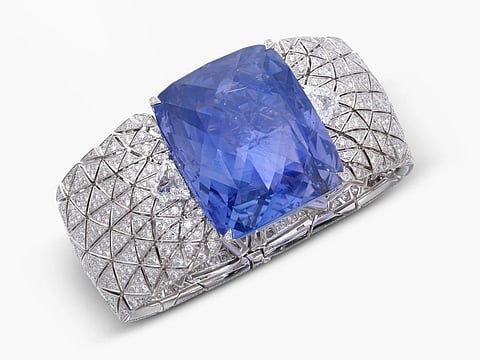
Leading the results was the 197.80-carat Romanov Sapphire, which sold for CHF 4.122 million at Sotheby’s Royal & Noble Jewels auction on November 11. More than doubling its pre-sale high estimate of CHF 1.7 million, the unheated Ceylon sapphire became the evening’s defining lot, its appeal rooted as much in its imperial Russian past as in its extraordinary size.
Mounted in a diamond and rock crystal bracelet by Cartier, the sapphire has travelled from the Russian imperial court through the hands of prominent collectors and jewellers. Its result underscored the premium collectors continue to place on jewels with an identifiable historical narrative.
The Romanov Sapphire’s origins are traced to the Russian Crown Jewels, although the precise date of its entry into the imperial collection remains undocumented. Its distinctive faceting suggests a Mughal-era origin, reflecting the movement of gemstones and cutting traditions across continents.
The 197.80-carat stone originates from Sri Lanka and was once mounted in a diamond setting by Fabergé. Its most celebrated documented appearance came at the 1903 Winter Palace Ball in St Petersburg, where Dowager Empress Maria Feodorovna, mother of Russia’s last emperor Nicholas II, wore it alongside a second, larger sapphire on her elaborate court costume.
Following the Russian Revolution, the imperial treasures were inventoried in the Fersman catalogue between 1924 and 1926. The sapphire was recorded alongside its original companion stone before entering the Soviet government's dispersal sales.
In 1927, opera singer and jewellery collector Ganna Walska acquired the gemstone from Cartier. She subsequently commissioned different settings for it, including a sautoir featuring a carved 256.60-carat Mughal emerald. After appearing at Sotheby’s New York in 1971 and Geneva in 1992, the sapphire received its present architectural setting in 2015. Cartier designed a geometric diamond bracelet with an interchangeable rock crystal centre, allowing the historic stone to remain the focus.

The Romanov Sapphire was not the only jewel at Sotheby’s to benefit from its royal associations. A sapphire and diamond demi-parure comprising a necklace and pendant earrings, associated with Princess Sibylla of Sweden, achieved CHF 832,000. Presented as a wedding gift by Tsar Ferdinand of Bulgaria in 1932, the set was traditionally believed to have belonged to Maria Feodorovna, further connecting it to the Russian imperial narrative.
Another notable offering was a diamond tiara by Mellerio dits Meller, first exhibited at the International Exhibition of 1862 before becoming a royal wedding gift for Marie Isabelle d’Orléans. The auction also featured emerald and diamond jewels belonging to Queen Amélie of Portugal, including a bangle centred on a 27.38-carat Colombian emerald, alongside a sapphire and emerald ring formerly owned by Catherine, Lady Walston.
The results were part of a broader pattern across Geneva's auction calendar, where historic ownership proved a powerful differentiator.
The wider Geneva auctions offered further evidence of collectors' appetite for jewellery with a royal past. At Sotheby’s, a transformable Cartier opal tiara-necklace made in the late 1930s for Mary Cavendish, later Duchess of Devonshire, sold for CHF 1.664 million against an estimate of CHF 780,000 to CHF 1.1 million.
The piece had been worn as a necklace at Queen Elizabeth II’s coronation in 1953 and subsequently featured in the Victoria & Albert Museum’s 2025 Cartier exhibition. Its recent public appearances, including its use by filmmaker Emerald Fennell at the London premiere of Wuthering Heights in February 2026, added another chapter to its provenance.
A Belle Époque brooch set with a 23.64-carat padparadscha sapphire delivered one of the most striking results of the season. Formerly owned by Princess Sibylla and later her daughter Princess Birgitta, the jewel sold for CHF 1.12 million against an estimate of CHF 40,000 to CHF 60,000. Its significance extended beyond the gemstone: Birgitta had worn it at her wedding ball in 1961 and again at Crown Princess Victoria’s wedding in 2010.
At Phillips, a necklace commissioned by Queen Mary in 1928 from London jeweller Hennell, reproducing the Golden Jubilee necklace presented to Queen Victoria in 1888, achieved CHF 361,200, twice its high estimate. The piece had subsequently been given by Queen Mary to her niece, the Duchess of Beaufort.
The contrast between historic royal jewels and some of the season’s headline gemstones was particularly revealing.
At Christie’s, the 24-carat Bulgari Pink, an emerald-cut fancy intense pink diamond, sold for CHF 12.1 million, within its pre-sale estimate of CHF 10 million to CHF 15 million. Although the stone had been acquired in India in the 1950s by the consignor’s great-grandparents and subsequently set by Bulgari in Rome, its family history remained undisclosed.
The wider auction results were not uniformly buoyant. Christie’s Geneva sale realised CHF 41.5 million, below the CHF 60.62 million achieved the previous year. Yet coloured gemstones and distinctive signed designs found buyers willing to exceed expectations. A 54.76-carat Ceylon sapphire brooch more than tripled its high estimate, while a Van Cleef & Arpels Zip necklace and earrings set from 1952 sold for more than twice its high estimate.
For the jewellery trade, Geneva offered a useful distinction between the value of an exceptional gemstone and the value of an exceptional jewel. Size, colour and craftsmanship remain fundamental, but historical ownership, royal associations and a well-documented journey can transform a collectible object into something considerably more compelling.
The Romanov Sapphire's CHF 4.122 million result was a particularly vivid illustration. Its appeal lay not simply in 197.80 carats of unheated Ceylon sapphire, but in the extraordinary history it carried from the Winter Palace to the modern auction room.